
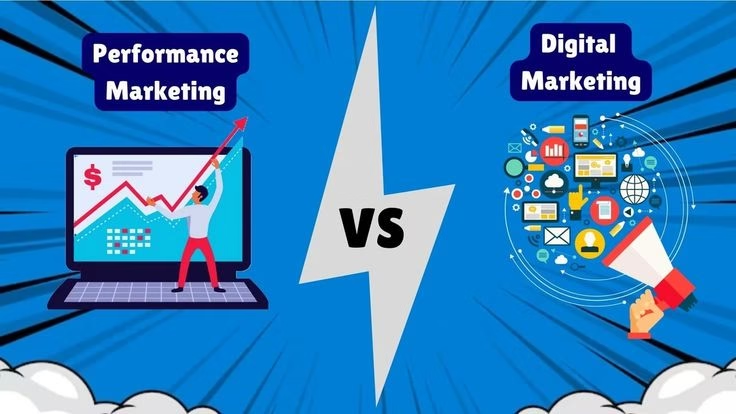

The digital landscape is often a whirlwind of acronyms and overlapping strategies. To the uninitiated, “Digital Marketing” and “Performance Marketing” might sound like two ways of saying the same thing. After all, they both happen on the internet, they both involve ads, and they both aim to grow a business.
However, as any seasoned marketer will tell you, the distinction between the two is profound. It’s the difference between the ocean (Digital Marketing) and the current that pulls a ship toward a specific port (Performance Marketing).
Understanding this nuance isn’t just an academic exercise—it’s a financial necessity. Choosing the wrong framework for your goals can lead to wasted budgets, misaligned KPIs, and a lot of frustrated stakeholders.
Defining the Terms

What is Digital Marketing?
Digital marketing is the umbrella term for all marketing efforts that use an electronic device or the internet. It is a broad discipline focused on building a brand’s presence, managing its reputation, and communicating with its audience across various digital touchpoints.
It encompasses everything from SEO and Content Marketing to Social Media and Email. The primary goal of digital marketing is often long-term brand equity. It’s about being “top of mind” when a consumer is ready to buy.
What is Performance Marketing?
Performance marketing is a subset of digital marketing. It is a comprehensive term for online marketing and advertising programs in which advertisers pay only when a specific action is completed. These actions could be a lead, a sale, a click, or a download.
In performance marketing, the “performance” is measurable and quantifiable in real-time. It is highly data-driven and focused on immediate ROI.2.
2. The Fundamental Philosophies

To truly grasp the difference, we have to look at the “Why” behind the strategies.
Digital Marketing: The Long Game
Digital marketing operates on the belief that a consumer needs to trust a brand before they buy from it. It focuses on the Marketing Funnel in its entirety:
- Awareness: Letting people know you exist.
- Consideration: Educating them on why you are better than competitors.
- Conversion: The final purchase.
Digital marketing is often “top-of-funnel.” It invests in things like high-quality blog posts, engaging Instagram stories, and community management. You might not see a sale the day you post a beautiful photo on Pinterest, but that photo builds a brand identity that pays off six months down the line.
Performance Marketing: The Sprint
Performance marketing is almost exclusively “bottom-of-funnel.” It cares less about how the customer feels about the brand and more about whether the customer clicked the button.
It operates on a Pay-for-Results model. If a campaign doesn’t result in the desired action (the “conversion”), the advertiser often doesn’t pay, or they quickly pivot the budget to a strategy that does work. It is the science of conversi
3. Key Differences: A Side-by-Side Comparison

| Feature | Digital Marketing | Performance Marketing |
| Primary Goal | Brand awareness, reputation, and engagement. | Specific actions (leads, sales, clicks). |
| Payment Model | Usually fixed fees or monthly retainers. | Pay-per-action (CPA, CPL, CPC). |
| Time Horizon | Long-term; results build over months/years. | Short-term; results are immediate. |
| Risk Factor | High risk for immediate ROI; low risk for brand longevity. | Low risk for budget (pay for results); high risk for brand fatigue. |
| Measurement | Qualitative (sentiments) and Quantitative. | Purely Quantitative (data-driven). |
| Main Channels | SEO, Content, Organic Social, PR. | Paid Search, Affiliate, Programmatic, Social Ads. |
4. The Core Pillars of Digital Marketing

To see how these two coexist, we must look at the specific tools each one uses.
Search Engine Optimization (SEO)
SEO is the backbone of digital marketing. It’s about making your website “discoverable.” While it involves technical data, it’s largely a long-term play. You don’t pay Google to rank #1; you earn it through authority and content.
Content Marketing
Content is the “soul” of digital marketing. Whether it’s a 2,000-word guide or a 15-second TikTok, content builds the narrative. It’s rarely “performance-based” because it’s hard to attribute a single blog post to a sale that happens three weeks later via a direct search.
Social Media Management
This is about community. Responding to comments, maintaining a “vibe,” and engaging with followers. This builds loyalty, which is a digital marketing metric, not a performance one.
5. The Core Pillars of Performance Marketing

Affiliate Marketing
This is perhaps the purest form of performance marketing. A brand pays a commission to an external website (the affiliate) only when that affiliate sends a customer who completes a purchase. No sale, no commission.
Native Advertising / Sponsored Content
While this looks like content marketing, in a performance context, it’s about “clipping” the audience of a larger publication to drive immediate traffic to a landing page.
Paid Search (SEM)
When you bid on keywords in Google Ads, you are playing the performance game. You are targeting users with high intent—people who are looking to buy right now.
Social Media Advertising
Unlike organic social media, paid social ads (Facebook/Instagram/LinkedIn Ads) allow for granular targeting. You pay for the “Click” or the “Impression,” and you can track that user all the way to the “Thank You” page of your website.
6. How They Intersect: The “Hybrid”

In the modern era, the lines are blurring. You cannot have a successful performance campaign if your digital marketing is non-existent.
Scenario: You see a highly optimized Facebook ad for a new skincare brand (Performance Marketing). You click it, but you don’t buy. Instead, you go to their Instagram page to see if they are “legit.” You see 50,000 followers and beautiful, educational content (Digital Marketing). Satisfied, you go back and buy.
Who gets the credit? The truth is, both do. Performance marketing provided the spark, but digital marketing provided the fuel.
7. Metrics: How Success is Measured
Digital Marketing Metrics
- Reach & Impressions: How many eyes saw the content?
- Engagement Rate: Are people liking, sharing, and commenting?
- Share of Voice: How much of the online conversation do you own compared to competitors?
- Domain Authority: How “trustworthy” does Google think your site is?
Performance Marketing Metrics
- ROI (Return on Investment): For every $1 spent, how much did we make?
- ROAS (Return on Ad Spend): Gross revenue generated per dollar spent on advertising.
- CPA (Cost Per Acquisition): How much did it cost to get one new customer?
- LTV (Lifetime Value): How much is that customer worth over the next year?
8. Which One Should You Choose?

The answer depends on your business stage and your goals.
Choose Digital Marketing If:
- You are a new brand looking to establish an identity.
- You want to build a “moat” around your business through organic search and community.
- You have a long sales cycle (e.g., B2B software) where trust is more important than a quick discount.
Choose Performance Marketing If:
- You have a clear product-market fit and need to scale sales quickly.
- You have a tight budget and need to see a direct return on every dollar.
- You are running a seasonal promotion or launching a specific product.
10. The Data Revolution: Why Performance Marketing is Dominating the Conversation
In the current economic climate, the shift toward performance marketing has accelerated. Why? Because transparency is the ultimate currency.
In the traditional digital marketing world, “Brand Awareness” was often criticized for being “fluffy.” It was difficult to prove to a CEO exactly how a viral tweet translated into rent money. Performance marketing changed that narrative. With the advent of sophisticated tracking pixels and AI-driven attribution models, marketing moved from a “cost center” to a “revenue generator.”
However, this data-heavy approach comes with a warning. Relying solely on performance metrics can lead to “Brand Decay.” If you only run ads that are optimized for clicks, your creative often becomes repetitive, aggressive, or “salesy.” Over time, this erodes the prestige of your brand. A company that only does performance marketing is essentially a commodity; a company that balances it with digital brand-building is an icon.
11. The Role of Artificial Intelligence (AI)

AI is the bridge currently fusing these two worlds. In the past, “Digital Marketing” required human intuition to understand brand sentiment, while “Performance Marketing” required humans to crunch spreadsheets.
Today:
- AI in Performance: Algorithms (like Google’s “Performance Max” or Meta’s “Advantage+”) now handle the bidding and targeting in real-time. They can process millions of data points to find the exact user most likely to convert, making performance marketing more efficient than ever.
- AI in Digital: Large Language Models and generative tools allow brands to produce high-quality “brand” content (blogs, videos, social posts) at scale. This lowers the cost of the “Long Game,” making broad digital marketing accessible to small businesses that previously could only afford direct-response ads.
12. Attribution: The Great Challenge
The biggest conflict between these two disciplines lies in Attribution—the science of determining which touchpoint gets credit for a sale.
Digital marketing often suffers from the “Last Click” bias. A customer might see five of your educational blog posts and follow you on LinkedIn for three months (Digital Marketing), but they only finally buy after clicking a retargeting ad (Performance Marketing). In a strict performance model, the ad gets 100% of the credit.
Savvy marketers are moving toward Multi-Touch Attribution (MTA). This model acknowledges that while the performance ad closed the deal, the digital marketing efforts did the “heavy lifting” of moving the customer through the funnel.
13. Budgeting for Both
A common question for CMOs is: How do I split my budget?
While every industry differs, a classic rule of thumb is the 60/40 Rule:
- 60% to Digital Branding: Focused on long-term growth, SEO, and organic reach. This ensures the “top of the funnel” stays full.
- 40% to Performance: Focused on direct response, lead gen, and sales. This ensures the “bottom of the funnel” is converting efficiently.
In a startup phase, you might flip this—80% performance—to generate the cash flow needed to survive. As you mature, you must shift back toward branding to lower your long-term Customer Acquisition Cost (CAC). Organic digital marketing is essentially an investment that lowers the “tax” you pay to platforms like Google and Meta.
14. Summary: The Future is “Phygital” and Integrated
The wall between performance and digital marketing is crumbling. We are entering an era of Brand-Led Performance. This means creating advertisements that don’t look like “ads”—they look like valuable, high-quality content, but they are backed by the rigorous tracking and optimization of a performance engine.
To win in 2026 and beyond, you must be a scientist of the data (Performance) and a poet of the brand (Digital). One provides the logic; the other provides the emotion. Together, they create a marketing machine that isn’t just “present” online, but is profitable, sustainable, and beloved by its audience.
Conclusion: The Unified Strategy
In the debate of Performance Marketing vs. Digital Marketing, there is no “winner.”
Performance marketing is the engine that drives immediate revenue, but digital marketing is the chassis that holds everything together and the brand that makes the car worth driving in the first place.
The most successful companies today don’t choose between them. They use Digital Marketing to tell a story and build a world that people want to be part of, and they use Performance Marketing to make sure those people have a clear, tracked path to making a purchase.
By balancing the two, you ensure that you aren’t just buying customers today, but building a brand that will keep them coming back tomorrow.
auther:afnan
Digital Marketing vs Performance Marketing