

The Ultimate Guide to Driving Profitable Growth
Google Ads has evolved into one of the most precise and scalable digital advertising platforms available today. With billions of searches happening daily, it enables businesses to connect with users who are actively looking for products, services, or solutions. A strong Google Ads Strategy ensures that your brand appears at the right time, in the right place, and with the right message—turning user intent into measurable business outcomes through targeted and data-driven advertising.
In 2026, competition within Google Ads Strategy execution is more intense than ever. Automation, AI-powered bidding, and smarter audience targeting have raised the bar, making casual or unplanned advertising ineffective. Brands that succeed treat Google Ads Strategy as a performance-driven system rather than a simple traffic source, aligning campaign goals with core business objectives while optimizing every step of the customer journey.
A well-structured Google Ads Strategy not only drives qualified clicks but also improves lead quality, lowers customer acquisition costs, and maximizes return on ad spend. Without a clear Google Ads Strategy, advertisers risk wasted budgets, irrelevant traffic, and inconsistent performance. This guide delivers practical, paragraph-driven insights to help you build a profitable, scalable, and future-ready Google Ads Strategy that delivers long-term results.
What Is a Google Ads Strategy?
A Google Ads Strategy is a comprehensive, data-driven framework that defines how a business plans, executes, measures, and optimizes paid advertising across the entire Google Ads ecosystem. This Google Ads Strategy goes far beyond selecting keywords or setting daily budgets; instead, it aligns paid advertising efforts with core business goals such as revenue growth, lead quality, cost to acquire a customer, long-term customer value, and advertising profitability
At its core, a successful Google Ads Strategy answers critical performance questions: Who is the target audience? What problems are they trying to solve? Which high-intent keywords indicate strong purchase intent? What ad messaging will resonate at each stage of the buying journey? When these elements are clearly defined, a Google Ads Strategy delivers more efficient, predictable, and scalable campaign results.
A structured Google Ads Strategy also ensures consistency across campaigns. From keyword targeting and ad copywriting to landing page optimization and bidding strategies, every component of the Google Ads Strategy works together to improve relevance and performance. This alignment directly impacts Quality Score, cost-per-click (CPC), click-through rate (CTR), and conversion rates.
Without a defined Google Ads Strategy, advertising becomes reactive and inefficient. With a well-planned Google Ads Strategy, Google Ads transforms into a scalable growth engine driven by data, insights, testing, automation, and continuous optimization
Option 1 – Clear & Professional
An effective Google Ads strategy typically integrates multiple campaign formats to engage users at every stage of the customer journey.
Option 2 – Marketing-Focused
The most successful Google Ads strategies blend different campaign types to support awareness, consideration, and conversion throughout the full funnel.
Option 3 – Growth-Oriented
High-performing Google Ads strategies leverage a mix of campaign types to reach, nurture, and convert customers across the entire buying journey.
Option 4 – Simple & Direct
To maximize results, Google Ads strategies usually combine several campaign types to guide users from discovery to purchase.
Option 5 – Premium / Expert Tone
A well-structured Google Ads strategy strategically combines multiple campaign types to ensure consistent visibility and performance across the complete customer lifecycle.
If you want, I can also tailor it for SEO blogs, agency websites, or Google Ads landing pages.
Setting Clear Google Ads Goals

Every successful Google Ads strategy begins with clear and measurable objectives.
Common goals include:
- Increasing website traffic
- Generating qualified leads
- Driving online sales
- Boosting brand awareness
- Promoting app installs
Each goal influences:
- Campaign type selection
- Bidding strategy
- Ad creatives
- Conversion tracking setup
Without defined goals, optimization becomes impossible.
Keyword Research: The Foundation of Google Ads Strategy
Keyword research is the backbone of any successful Google Ads strategy because it determines when and where your ads appear. Selecting the right keywords ensures that your ads are triggered by users with genuine intent, rather than casual browsers. Poor keyword choices lead to wasted spend, low conversion rates, and irrelevant traffic.
Effective keyword research begins with understanding user intent. Search queries generally fall into informational, navigational, or transactional categories. For Google Ads, transactional and high-intent commercial keywords typically deliver the best ROI. These keywords indicate that users are closer to making a decision or purchase.
In addition to identifying profitable keywords, advertisers must evaluate search volume, competition, and estimated cost-per-click. High-volume keywords may drive traffic, but they are often expensive and less targeted. Long-tail keywords, while lower in volume, frequently produce higher conversion rates at a lower cost.
Negative keywords are equally important. By excluding irrelevant searches, you protect your budget and improve campaign efficiency. Over time, refining keyword lists based on search term reports strengthens performance and ensures sustained profitability.
Structuring Google Ads Campaigns for Maximum Performance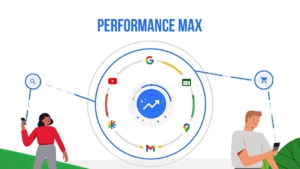
Campaign structure directly impacts Quality Score, cost-per-click, and conversion rates.
Best Practices for Campaign Structure
- Separate campaigns by goal
- Organize ad groups by tightly themed keywords
- Use one primary intent per ad group
- Align ads closely with keywords
A well-structured account improves relevance, lowers costs, and simplifies optimization.
Crafting High-Performing Google Ads Copy
Ad copy connects user searches to meaningful actions. Even with precise targeting, ineffective messaging can limit clicks and conversions. High-performing Google Ads copy aligns closely with user intent while clearly highlighting value and differentiation.
Effective ad copy starts with relevance. Headlines should mirror the searcher’s query, instantly signaling that your solution matches their needs. Descriptions should emphasize key benefits, solve customer pain points, and clearly explain what sets your offer apart from competitors.
Compelling calls-to-action are essential for encouraging interaction. Action-oriented phrases such as “Request a Free Quote,” “Start Your Free Trial,” or “Schedule a Demo” prompt users to take the next step. Incorporating trust elements like customer reviews, certifications, or money-back guarantees helps reduce hesitation and improves click-through rates.
Responsive Search Ads leverage Google’s machine learning to test multiple headline and description combinations. By supplying varied, benefit-focused messaging, advertisers allow Google to automatically optimize ad performance based on real-time user engagement and behavior.
Landing Page Optimization: Turning Clicks into Conversions
A Google Ads Strategy is only as effective as the landing page it directs traffic to. While ads generate impressions and clicks, landing pages play a critical role in conversions and overall campaign success. In a high-performing Google Ads Strategy, slow load times, cluttered layouts, or mismatched messaging can significantly reduce conversion rates and waste ad spend.
An optimized Google Ads Strategy ensures strong message consistency between the ad copy and the landing page experience. When users see the same promise, offer, and keyword theme they clicked on, trust is built instantly. This alignment within a Google Ads Strategy directly improves user engagement and conversion performance.
Clarity is essential to any successful Google Ads Strategy. Landing page headlines should clearly communicate the core value proposition, while supporting content highlights key benefits in simple, scannable language. A single, prominent call-to-action strengthens the Google Ads Strategy by guiding users toward one clear next step.
Mobile optimization is a non-negotiable element of a modern Google Ads Strategy. With most Google Ads traffic coming from mobile devices, landing pages must load quickly, display correctly, and deliver a seamless user experience across all screen sizes. A mobile-first Google Ads Strategy ensures higher Quality Scores, lower cost-per-click, and stronger conversion rates
.
Bidding Strategies Explained
Choosing the right bidding strategy aligns your spend with your goals.
Manual Bidding
- Manual CPC
- Enhanced CPC
Automated Bidding
- Maximize clicks
- Maximize conversions
- Target CPA
- Target ROAS
Automation works best when conversion tracking is accurate and sufficient data is available.
Budget Allocation and Spend Control
Budget mismanagement is one of the biggest causes of Google Ads failure.
Smart Budgeting Tips
- Allocate more budget to high-intent campaigns
- Separate testing and scaling budgets
- Monitor daily spend limits
- Reinvest in top-performing keywords and ads
Strategic budgeting ensures consistent performance without overspending.
Conversion Tracking and Analytics
A Google Ads strategy without tracking is guesswork.
Essential Tracking Setup
- Google Ads conversion tracking
- Google Analytics 4 integration
- Call tracking
- Enhanced conversions
Tracking enables accurate bidding, smarter optimization, and ROI measurement.
Quality Score Optimization
Quality Score affects ad rank and cost-per-click.
Key Factors
- Keyword relevance
- Ad relevance
- Landing page experience
- Expected click-through rate
Improving Quality Score reduces costs while increasing visibility.
Remarketing and Audience Targeting
Remarketing re-engages users who have already interacted with your brand.
Remarketing Options
- Website visitors
- Cart abandoners
- YouTube viewers
- App users
Audience layering allows for hyper-targeted campaigns that convert at lower costs.
Performance Max Strategy Best Practices
Performance Max campaigns leverage AI but still require strategic input.
Optimization Tips
- Use high-quality creative assets
- Provide clear audience signals
- Track high-value conversions
- Monitor search term insights
Automation performs best when guided by clear business data.
Common Google Ads Strategy Mistakes to Avoid
- Ignoring negative keywords
- Sending traffic to weak landing pages
- Chasing clicks instead of conversions
- Poor campaign structure
- Not testing ad creatives
Avoiding these mistakes can significantly improve ROI.
Google Ads Strategy for Different Business Types
Small Businesses
- Focus on local and high-in
Conclusion
A successful Google Ads strategy is built on clear objectives, precise targeting, and continuous optimization. Rather than focusing only on clicks or impressions, effective campaigns prioritize meaningful conversions and measurable business results. By aligning keyword research, campaign structure, ad copy, and landing page experience, advertisers can significantly improve efficiency and return on ad spend.
As Google Ads continues to evolve with AI and automation, long-term success depends on balancing technology with strategic human oversight. When managed thoughtfully, Google Ads becomes more than an advertising platform—it becomes a scalable growth engine that drives consistent leads, sales, and competitive advantage in an increasingly digital marketplace.
Author:Afnan